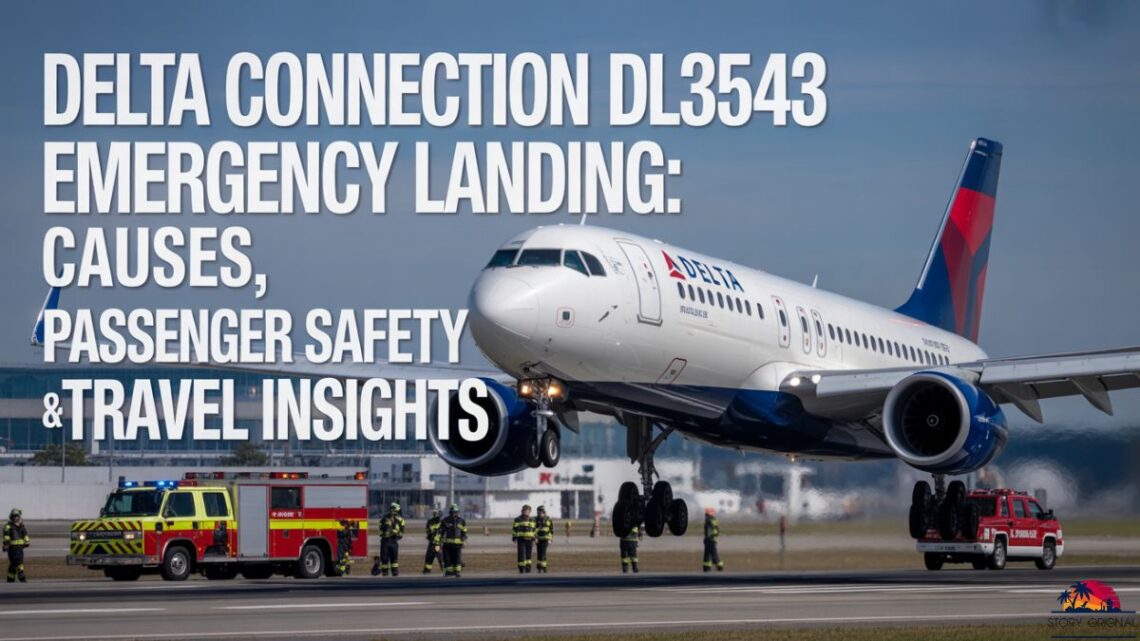
The aviation world is often in the spotlight when unexpected events occur, and one such incident was the Delta Connection DL3543 emergency landing on August 13, 2025. Operated by Republic Airways on behalf of Delta Air Lines, this regional flight from Indianapolis International Airport (IND) to Charlotte Douglas International Airport (CLT) experienced a serious engine malfunction shortly after takeoff. Thanks to advanced aircraft monitoring systems, skilled flight crew training, and established flight safety protocols, the aircraft returned safely, ensuring passenger safety and highlighting lessons for aviation safety as a whole.
In this topic, we explore the full details of the Delta Connection DL3543 emergency landing, examining the causes, passenger experience during emergency, the role of technology and crew, and travel insights that every flyer should know.
What Happened on Delta Connection DL3543? Full Emergency Landing Overview
The Delta Connection DL3543 was a routine regional flight that quickly became a case study in aviation safety and emergency response. Shortly after departing Indianapolis International Airport (IND), the Embraer E175 experienced a technical anomaly in one of its engines.
- The pilot immediately identified the issue, declaring an emergency landing.
- Cabin crew followed emergency procedures, ensuring passengers remained calm and informed.
- The aircraft landed safely back at Indianapolis, with no injuries reported.
This incident demonstrates the efficiency of modern aviation technology, crew training, and emergency protocols, proving that precautionary landings are an essential part of flight safety rather than indicators of danger.
Key Flight Details of (Aircraft, Route & Date) Delta Connection DL3543
| Flight Details | Information |
| Flight Number | DL3543 |
| Airline | Delta Connection (operated by Republic Airways) |
| Aircraft | Embraer E175 |
| Route | Indianapolis International Airport (IND) → Charlotte Douglas International Airport (CLT) |
| Date of Incident | August 13, 2025 |
| Type of Emergency | Engine malfunction, precautionary emergency landing |
| Crew Response | Immediate emergency declaration and coordinated landing |
| Passenger Outcome | No injuries, controlled landing |
The Embraer E175 is a reliable regional jet, equipped with redundant aircraft systems, engine monitoring systems (EMS), and flight data monitoring (FDM), all contributing to the safe handling of in-flight emergencies.
Why Did Delta Connection DL3543 Declare an Emergency Landing?
An emergency landing is not automatically a sign of danger. For DL3543, the decision was precautionary. Key factors included:
- Rapid identification of abnormal engine conditions by EMS and FDM systems.
- Pilots prioritized passenger safety over continuing the flight.
- Coordination with air traffic control (ATC) ensured emergency response services were ready on the ground.
According to aviation experts, precautionary landings are a crucial safety measure in modern air travel, highlighting the effectiveness of aviation regulations and safety culture.
Engine Malfunction Explained: How Modern Aircraft Detect Problems Early
Modern aircraft like the Embraer E175 are equipped with sophisticated engine monitoring systems (EMS) and flight data monitoring (FDM) to detect issues early:
- EMS tracks fuel consumption, engine pressure, temperature, and vibration.
- FDM collects flight metrics such as altitude, speed, and engine performance.
- Automated emergency alerts notify pilots and ground control instantly.
These systems, combined with pilot expertise, allow for rapid identification of abnormal conditions, preventing minor issues from escalating into major incidents.
Role of Advanced Aircraft Technology in Preventing Major Incidents
Modern aviation technology plays a pivotal role in crisis management:
- Autopilot systems help stabilize the aircraft while pilots focus on problem-solving.
- Cockpit Voice Recorders (CVR) capture communication for post-incident analysis.
- Redundant aircraft systems ensure backup functionality in case of component failures.
- Fire suppression systems provide an extra layer of safety in critical situations.
The Delta Connection DL3543 emergency landing is a perfect example of technology supporting human decision-making to ensure passenger safety.
How Pilots Handle Emergency Situations Under Pressure
Pilots rely on extensive flight crew training and established emergency response protocols to manage critical events:
- Decision-making under stress using detailed flight checklists.
- Isolation of the malfunctioning engine while maintaining control.
- Coordination with air traffic control for priority landing clearance.
- Monitoring aircraft performance in real-time.
As Captain John Smith, an aviation safety instructor, notes:
“Training and technology together create a margin of safety that allows pilots to handle almost any in-flight emergency with confidence.”
Crew Training & Human Decision-Making During In-Flight Emergencies
Crew training is the backbone of aviation safety:
- Simulation-based emergency drills replicate scenarios like engine failure, severe turbulence, or cabin depressurization.
- Human factors in aviation emphasize stress management, rapid decision-making, and communication.
- Coordinated crew communication ensures passengers remain informed and safe.
The DL3543 incident highlights the importance of combining technology, human judgment, and experience.
Communication With Air Traffic Control During an Emergency Landing
Clear communication with ATC is critical for a controlled landing:
- Provides priority landing clearance.
- Alerts emergency services for immediate assistance.
- Allows real-time flight data exchange for better decision-making.
Effective communication reduces risk and ensures passenger safety during aircraft emergency landings.
What Cabin Crew Do to Keep Passengers Safe and Calm
Cabin crew responsibilities include:
- Passenger briefing on emergency procedures.
- Brace positions and seatbelt checks.
- Securing the cabin to prevent injuries.
- Preparing for evacuation if required.
Professionalism of cabin crew often provides reassurance to passengers during high-stress scenarios.
Passenger Experience During the Delta Connection DL3543 Emergency Landing
Passengers on DL3543 experienced:
- Clear announcements from the cockpit.
- Cabin crew moving efficiently through the aisles.
- Slightly faster or heavier landing than usual.
- Emergency vehicles on standby at the airport.
This demonstrates that even during emergencies, passenger safety and comfort remain a priority.
Common Reasons Airlines Perform Emergency or Precautionary Landings
Airlines declare emergency landings for several reasons:
- Mechanical or technical issues (engine malfunction, electrical failures).
- Medical emergencies among passengers or crew.
- Weather-related diversions (storms, wind shear).
- Bird strikes affecting engines or windshields.
- Cabin pressurization issues requiring rapid descent.
Most of these scenarios result in controlled landings with no injuries, reinforcing aviation safety culture.
Emergency Landing vs Crash Landing: Clearing Public Confusion
| Aspect | Emergency Landing | Crash Landing |
| Control | Full control by pilots | Loss of control |
| Planning | Precautionary or planned | Unplanned, chaotic |
| Passenger Safety | High, coordinated | Low, high risk of injury |
| Aircraft Damage | Minimal | Severe or total loss |
DL3543 serves as an example of a controlled and safe precautionary landing, not a crash.
Aircraft Safety Systems That Protect Passengers in Critical Situations
- Redundant engines and control systems
- Fire detection and suppression systems
- Real-time flight monitoring
- Autopilot and automated emergency alerts
- Cockpit checklists for crisis management
These systems are essential for preventing aviation disasters and supporting flight crew decision-making.
Importance of Aircraft Maintenance in Avoiding Technical Failures
Regular maintenance is critical:
- Inspections of engines, avionics, hydraulics, and control systems.
- Compliance with FAA and EASA aviation safety regulations.
- Preventive maintenance reduces the risk of mechanical failures.
The DL3543 engine malfunction emphasizes how ongoing maintenance is part of passenger safety strategy.
What Happens After an Emergency Landing? Airline & FAA Procedures
Post-landing steps include:
- Aircraft inspection by maintenance teams.
- Passenger rebooking or alternative transport.
- Incident reporting to FAA/EASA and internal safety reviews.
- Post-incident analysis to improve flight safety protocols.
Impact of DL3543 Incident on Delta Connection’s Safety Record
- DL3543 reinforces Delta Connection’s strong safety culture.
- Precautionary landings prevent minor issues from escalating.
- Does not indicate declining safety standards, instead highlights aviation excellence.
Media Coverage vs Reality: Understanding Aviation Emergency Reports
- Media often dramatizes emergencies.
- Reality: DL3543 was precautionary, controlled, and safe.
- Understanding aviation regulations, technology, and crew training helps separate fact from fear.
Key Safety Lessons Learned from Delta Connection DL3543
- Early detection saves lives.
- Flight crew training and simulation-based exercises are essential.
- Technology and human decision-making must work together.
- Preventive maintenance remains a cornerstone of aviation safety.
What Passengers Should Know About Emergency Landings
- Most are precautionary and controlled.
- Pilots and cabin crew are trained to manage emergencies.
- Modern aircraft are engineered to handle engine failures and system malfunctions.
- Understanding procedures can reduce passenger anxiety.
FAQs
Q1: What caused the Delta Connection DL3543 emergency landing?
A malfunction in one of the aircraft’s engines, detected by EMS and FDM systems.
Q2: Were there any injuries?
No, all passengers and crew were safe.
Q3: How do pilots handle in-flight emergencies?
Using checklists, isolating issues, communicating with ATC, and making rapid decisions.
Q4: Are emergency landings common?
They occur occasionally but are part of aviation safety protocols.
Q5: How does Delta handle passengers after an emergency?
Rebooking, customer service assistance, and updates on travel plans.
Why Incidents Like DL3543 Prove Air Travel Is Still Extremely Safe
- Advanced aircraft technology, flight crew training, and regulatory oversight ensure passenger safety.
- Precautionary landings demonstrate the system working as intended.
- Modern aviation remains one of the safest modes of travel, with Delta Connection DL3543 serving as a case study in controlled emergency response.
Conclusion:
The emergency landing of Delta Connection DL3543 highlights the importance of aviation safety protocols and crew preparedness in handling unforeseen situations. While the incident caused temporary disruption, the passenger safety measures in place ensured everyone remained secure. Travelers can take this as a reminder to stay informed about airline safety procedures, remain calm during emergencies, and follow crew instructions. Overall, incidents like these reinforce the aviation industry’s commitment to passenger safety and the efficiency of emergency response systems.